


Bore & Groundwater Quality: Test First, Treat Second
Bore water can look perfectly clear and still contain dissolved chemicals, salts or microorganisms that you cannot see.
For Australian households, groundwater can be a valuable water source. But being underground does not automatically make it purified or safe to drink.
Its quality depends on local geology, surrounding land use, bore construction and what happens during storage and distribution.
Before choosing a filter, the most useful first step is simple:
Find out what is actually in the water.
Where does bore water come from?
Groundwater forms when water moves beneath the surface and collects in the spaces and fractures within soil, sediment and rock.
An underground formation that can supply usable quantities of groundwater is called an aquifer. Bores and pumps bring that water to the surface.
As water travels underground, it can dissolve minerals and other naturally occurring substances. It may also encounter contamination from human activities.
This is why a neighbour’s satisfactory water report cannot establish that your bore is suitable for drinking.
Doesn’t the ground naturally filter the water?
Soil and rock can remove some particles as water moves through them. However, this process does not reliably remove every harmful microorganism or dissolved chemical.
Groundwater can be affected by sewage, animal waste, agricultural runoff, industrial pollution and naturally occurring substances such as arsenic.
Contamination can also move underground and persist long after the original release. Clear water and a clean-looking property do not rule out contamination beneath the surface.
Is clear bore water safe to drink?
Appearance, taste and smell cannot establish safety.
NSW Health recommends that groundwater should not be used for drinking, cooking or personal hygiene—including teeth cleaning and bathing—without testing and appropriate treatment, including disinfection.
Where a public drinking-water supply is available in urban areas, NSW Health recommends using it for these purposes.
An untreated garden bore should therefore not automatically become a household drinking supply.
Are deeper bores safer than shallow bores?
Shallow or unconfined groundwater is generally more exposed to contamination from surface activities.
A properly constructed bore drawing from a deep, confined aquifer may have a lower microbial risk. However, deeper water can still contain substantial dissolved minerals, metals or naturally occurring radioactive substances.
Bore depth alone does not establish drinking-water quality. The source needs a chemical assessment as well as consideration of microorganisms.
What are the possible health implications?
The risks depend on the substance, its concentration and the amount and duration of exposure. Not every bore contains all—or any—of the following problems.
Microorganisms and gastrointestinal illness
Contamination from sewage, animal waste or surface water can introduce disease-causing organisms.
These can cause gastrointestinal illness, including diarrhoea, vomiting and abdominal discomfort. Water that is suitable for irrigation may still be unsuitable for drinking or food preparation.
Nitrate and young infants
Nitrate can enter groundwater from fertilisers, animal waste and wastewater.
Elevated nitrate is particularly concerning for young infants because it can interfere with the blood’s ability to carry oxygen—a condition called methaemoglobinaemia.
Do not use untested bore water to prepare infant formula. Boiling does not remove nitrate and can increase its concentration as water evaporates.
Arsenic and long-term exposure
Arsenic can occur naturally in groundwater because of local geology.
Long-term exposure to elevated inorganic arsenic in drinking water can cause skin changes and increase the risk of cancers, including skin, bladder and lung cancer.
This is a reason to test where arsenic is relevant—not a reason to assume every Australian bore contains dangerous levels.
Salinity and sodium
Salty groundwater can be unpleasant to drink and unsuitable for some household uses.
Sodium in drinking water may also matter for people following a medically prescribed low-sodium diet. A laboratory result is more useful than taste alone when assessing that contribution.
Hardness is a different issue
Calcium and magnesium can cause scale without making the water toxic. Hardness is primarily a maintenance concern and should not be confused with contamination by arsenic, nitrate or pathogens.
What should bore water be tested for?
Ask a NATA-accredited laboratory to help select a drinking-water test panel appropriate to the property.
Explain where the bore is located, how the water will be used and whether nearby activities could affect it.

A standard panel will not necessarily include every pesticide, industrial chemical or PFAS compound. Tell the laboratory about potential contamination sources so relevant tests are included. NSW Health also recommends considering radiological quality in groundwater assessments.
Contact the laboratory before collecting samples. Different tests may require specific containers, sampling methods and delivery times.
Can a handheld water tester tell me whether it is safe?
A handheld TDS or conductivity meter can help indicate dissolved mineral content. It cannot identify all the substances present or establish that water is free from pathogens.
A low reading is not a certificate of safety, and a high reading does not tell you which treatment is required.
Use laboratory analysis to investigate drinking-water suitability.
Why can’t I simply install a three-stage filter?
Because the number of cartridges does not tell you which problems the system can solve.
Different issues need different treatment mechanisms:
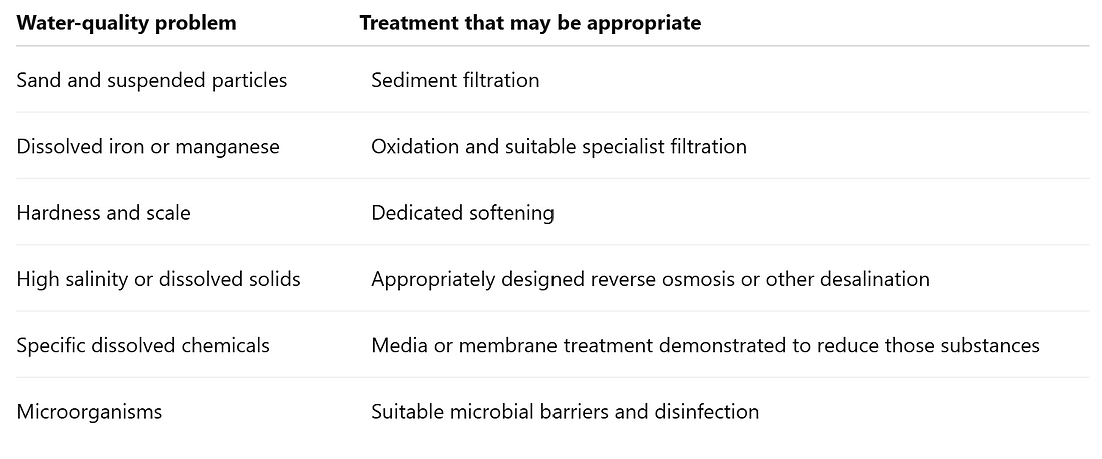
A sediment-and-carbon system may form part of a treatment setup. It should not be assumed to make an unknown bore supply safe.
Where does reverse osmosis fit?
Reverse osmosis can reduce dissolved salts and a range of other dissolved substances. Its suitability depends on the contaminant, concentration and operating conditions.
There is a substantial difference between:
-
Kitchen RO: producing drinking and cooking water at a dedicated outlet.
-
Whole-property desalination: treating enough water for the home or other large-volume uses.
A household RO unit is not automatically suitable for highly saline groundwater. The treatment supplier must check feed-water limits, pressure, pretreatment, capacity and reject-water disposal.
Iron, sediment and scale-forming minerals may need treatment before the membrane.
What about UV disinfection?
UV can inactivate microorganisms when the equipment delivers the required dose under suitable conditions.
It does not remove dissolved salts, nitrate, arsenic or other chemicals.
Incoming water must meet the unit’s clarity and other water-quality requirements. Appropriate prefiltration, flow control, maintenance and fault protection are therefore part of the design.
Does boiling make bore water safe?
Boiling can address many microbial hazards, but it does not desalinate water or remove nitrate and many other dissolved chemicals.
If chemical contamination is suspected, use an alternative safe drinking supply while the problem is assessed. Boiling is not a substitute for groundwater testing and appropriate treatment.
Protect the bore and storage system
Treatment works best alongside source protection.
Keep the borehead sealed and protected from surface runoff, flooding, livestock and nearby contamination. Check storage tanks and pipework as well as the bore itself.
After flooding, damage or a change in water quality, obtain advice before continuing household use.
How do I know treatment is working?
A treatment proposal should explain:
-
which measured problems it addresses;
-
the incoming water conditions it can handle;
-
the required maintenance and replacement intervals;
-
how treated-water quality will be checked.
Testing after commissioning helps confirm performance. Agree on ongoing checks with the laboratory or treatment specialist, including reassessment after changes to the supply.
Explore relevant options from Pure Water 4 Life
Our products may form part of a bore-water treatment system, but we need to assess the laboratory report before recommending a setup.
Premium Whole House Water Filter
This system combines sediment filtration, carbon filtration and an Aragon Plus cartridge.
It may be relevant after any necessary specialist pretreatment. It is not a desalination system or a complete disinfection system, and the product guidance asks customers to contact us before purchasing for bore water.
Explore the Premium Whole House Water Filter
Premium 4-Stage Reverse Osmosis System
Our under-sink RO system may be suitable for additional drinking-water treatment where the incoming supply meets its operating requirements.
Selection needs to account for the identified contaminants, their concentrations and any pretreatment required. It should not be assumed suitable for very salty or heavily mineralised bore water without assessment.
Explore the Premium 4-Stage Reverse Osmosis System
Send us your results before buying
Email your laboratory report to sales@purewater4life.com.au and include:
-
whether you need drinking water only or treatment for the whole home;
-
your approximate daily water requirements;
-
any existing pumps, tanks or treatment equipment.
We can explain where our range may help and when specialist equipment outside our range is needed.
Test first. Match treatment to the results. Then verify the water reaching your tap.
Sources & Further Reading
-
NSW Health — Groundwater: Bore-water contamination risks, testing and safe use.
-
NSW Health — Groundwater treatment fact sheet (PDF): Groundwater sources, potential hazards and treatment considerations.
-
NHMRC — Australian Drinking Water Guidelines: The national framework for assessing and managing drinking-water quality.